Volume #45 – 2 – 5

Biofilms are complex communities of microorganisms enclosed in a self-produced matrix of extracellular polymeric substances consisting of polysaccharides, proteins, lipids and extracellular DNA. These biofilms can form on a variety of surfaces and pose a major challenge in both the medical and industrial sectors as they can harbor pathogenic microorganisms. In healthcare, biofilms form on hospital surfaces, medical devices, patient tissue and implants and contribute to persistent infections that are difficult to treat. In the food industry, biofilms on processing equipment and food matrices can also lead to contamination and pose a serious threat to public health through foodborne diseases. The bacteria embedded in biofilms are much more tolerant to antimicrobial treatments than their planktonic counterparts, necessitating the development of new strategies to combat biofilm-associated infections and contamination. As biofilms mature, they become even more resistant to conventional treatments, making prevention strategies particularly important. This review focuses on enzyme-based strategies that have been developed over the last decade to inhibit biofilm formation. Key approaches such as disruption of microbial signaling pathways and degradation of biofilm matrix components are highlighted, offering promising ways to prevent biofilm-related problems in both medicine and industry.
Continue ReadingVolume #45 – 2 – 5

Volume #45 – 2 – 4

Pertussis or whooping cough is a highly contagious, vaccine-preventable, respiratory disease caused by Bordetella pertussis, and transmitted through the respiratory tract (aerosol). According to the reports of the World Health Organization and Centers for Disease Control and Prevention, the incidence of pertussis shows periodical variations in certain regions of the world. As humans are the sole reservoir of this bacteria complete vaccination against pertussis and high vaccination coverage is of utmost importance for reducing the incidence and severity of the disease. Two types of pertussis vaccine are available: whole-cell (wP) and acellular pertussis (aP) vaccine. wP contains whole nonviable bacteria, while aP usually contains two or more protein components. These protein components include inactivated pertussis toxin, filamentous hemagglutinin, pertactin, and fimbriae. The acellular vaccine was developed in response to reports of adverse reactions upon administering the whole-cell vaccine in certain countries. Both vaccines are usually formulated with diphtheria and tetanus toxoids, and more recently a trend of combining more antigenic sources such as Haemophilus influenzae type b, hepatitis B, and inactivated poliovirus vaccine has been accepted in many countries, including Serbia. The wP vaccine stimulates a strong immune response more similar to infection, while the response to aP vaccine differs in this respect. Due to the difference in the types of immune response predominating with different types of pertussis vaccines, there are differences in the duration of protection, and it has been reported that wP induces more durable protection. For countries that have adopted aP increased monitoring is advised as well as the inclusion of booster doses. The special focus is on the vaccination of pregnant women to protect the newborns. Incited by the recent surge in pertussis cases in Serbia here we provide a comprehensive literature overview of pertussis vaccines.

Continue ReadingVolume #45 – 2 – 4

Volume #45 – 2 – 3

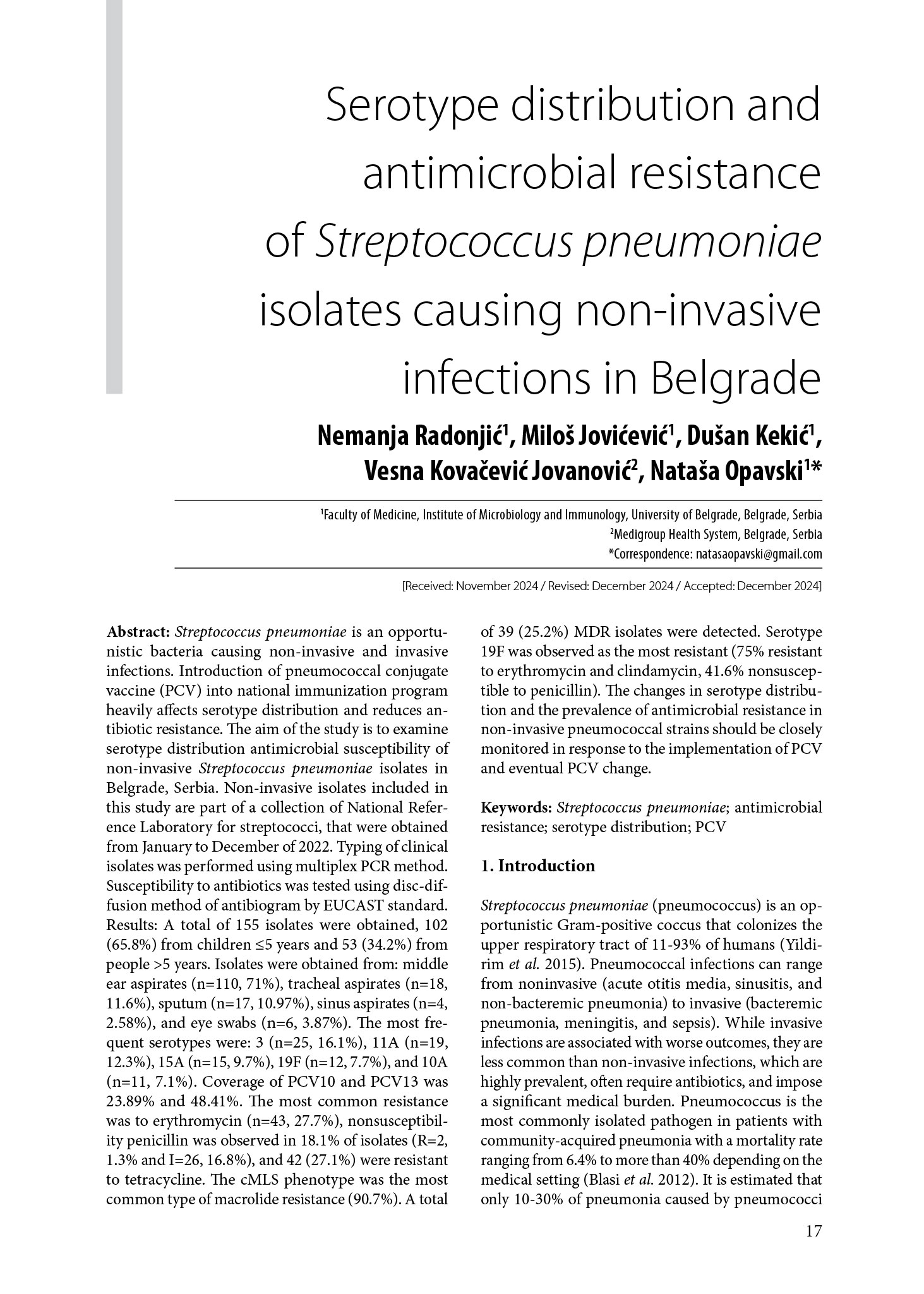
Streptococcus pneumoniae is an opportunistic bacteria causing non-invasive and invasive infections. Introduction of pneumococcal conjugate vaccine (PCV) into national immunization program heavily affects serotype distribution and reduces antibiotic resistance. The aim of the study is to examine serotype distribution antimicrobial susceptibility of non-invasive Streptococcus pneumoniae isolates in Belgrade, Serbia. Non-invasive isolates included in this study are part of a collection of National Reference Laboratory for streptococci, that were obtained from January to December of 2022. Typing of clinical isolates was performed using multiplex PCR method. Susceptibility to antibiotics was tested using disc-diffusion method of antibiogram by EUCAST standard. Results: A total of 155 isolates were obtained, 102 (65.8%) from children ≤5 years and 53 (34.2%) from people >5 years. Isolates were obtained from: middle ear aspirates (n=110, 71%), tracheal aspirates (n=18, 11.6%), sputum (n=17, 10.97%), sinus aspirates (n=4, 2.58%), and eye swabs (n=6, 3.87%). The most frequent serotypes were: 3 (n=25, 16.1%), 11A (n=19, 12.3%), 15A (n=15, 9.7%), 19F (n=12, 7.7%), and 10A (n=11, 7.1%). Coverage of PCV10 and PCV13 was 23.89% and 48.41%. The most common resistance was to erythromycin (n=43, 27.7%), nonsusceptibility penicillin was observed in 18.1% of isolates (R=2, 1.3% and I=26, 16.8%), and 42 (27.1%) were resistant to tetracycline. The cMLS phenotype was the most common type of macrolide resistance (90.7%). A total of 39 (25.2%) MDR isolates were detected. Serotype 19F was observed as the most resistant (75% resistant to erythromycin and clindamycin, 41.6% nonsusceptible to penicillin). The changes in serotype distribution and the prevalence of antimicrobial resistance in non-invasive pneumococcal strains should be closely monitored in response to the implementation of PCV and eventual PCV change.

Continue ReadingVolume #45 – 2 – 3

Volume #45 – 2 – 2

People with diabetes, particularly those with poorly controlled blood glucose levels, exhibit a 1.5 to 4-fold increased susceptibility to bacterial infections. This heightened vulnerability is primarily attributed to immune system dysfunctions exacerbated by hyperglycaemia. Impaired neutrophil and macrophage function, altered T-cell responses, and compromised skin and mucosal barriers all contribute to an impaired immune defence, increasing both the frequency and severity of infections. Hyperglycaemia directly affects neutrophil functions such as migration, phagocytosis, and apoptosis, while also promoting excessive neutrophil extracellular trap (NET) formation. Macrophages in diabetes tend to favour a pro-inflammatory M1 phenotype, impairing their ability to effectively clear pathogens. Additionally, T-cell dysfunction and altered antibody responses hinder adaptive immunity. Furthermore, the hyperglycaemic environment supports bacterial growth and enhances the virulence of pathogens such as Staphylococcus aureus and Group B Streptococcus , which thrive in this altered metabolic state. These bacteria produce various virulence factors that contribute to chronic infections and worsened outcomes. Collectively, the interplay of immune dysfunction and hyperglycaemia leads to an increased risk of persistent and severe infections in individuals with diabetes, necessitating a deeper understanding of the underlying mechanisms to improve clinical outcomes.

Continue ReadingVolume #45 – 2 – 2

Volume #45 – 2 – 1

Herpes simplex virus type 1 (HSV-1) and type 2 (HSV-2) represent highly prevalent human pathogens with high global prevalence rates of approximately 67% (HSV-1) and 13% (HSV-2). Manifestations of HSV-1 and HSV-2 infections include vesicular changes on the lips, genital herpes, herpetic stromal keratitis (HSK), eczema herpeticum, and systemic disease in newborns.

Continue ReadingVolume #45 – 2 – 1

Volume #45 – 1 – 5

Nontyphoidal Salmonella serotypes are diverse in their host range and vary in their pathogenic capability. They can cause huge economic losses due to human and animal infections worldwide. Biofilms are essential to the survival of microorganisms in their natural habitat, either the environment or the human body. This study aimed to investigate the ability of nontyphoidal Salmonella strains isolated from contaminated food of animal origin to produce biofilm in different incubation conditions such as nutrient media and incubation temperatures. Bacterial strains analyzed in this study were recovered from the food samples of animal origin in the Public Institution Veterinary Institute of the Republic of Srpska "Dr. Vaso Butozan" between 2017 and 2018 year. Biofilm production was determined by crystal violet assay in a microtiter plate in Trypticase-Soy (TSB) and Brainheart Infusion (BHI) broths during overnight incubation at 4 ℃, 25 ℃, and 37 ℃. A total of 30 Salmonella isolates were detected in 730 samples (4.1%), mainly from chicken meat (27 isolates). S. Infantis (14 isolates) and S. Enteritidis (12 isolates) were the two most common serotypes. As expected, none of the isolates were strong biofilm producers at all three incubation temperatures in both broths. Although the refrigeration temperature was the most unfavorable for biofilm creation, there were no significant statistical differences between tested incubation temperatures in BHI broth (p ≥ 0.05). In TSB broth, a significant statistical difference was found between isolates incubated at all three temperatures (p < 0.001, p < 0.001, p < 0.001). The lowest temperature was the least suitable for the formation of biofilm, whereas ambient temperature was the most favorable for biofilm production. When we compared the biofilm production in TSB and BHI broths, we observed that TSB was the better broth for efficient biofilm production only at 25 ℃ and 37 ℃ (p <0.001, p=0.049).  The temperature and medium composition are important for biofilm production. Salmonella's ability to form biofilms at ambient and refrigeration temperatures is significant in the poultry, catering, and household industries, allowing for long-term bacterial persistence.

Continue ReadingVolume #45 – 1 – 5

Volume #45 – 1 – 4

The human cytomegalovirus (CMV) is a ubiquitous pathogen and an important factor contributing to morbidity and mortality in patients with hematologic malignancies. Serological demonstration of prior exposure to CMV is essential in this population. A number of factors including gender and age may influence CMV seropositivity in patients with B-cell neoplasms as they do in healthy individuals. Herein, we have investigated CMV serostatus in non-transplanted patients with lymphoid B-cell malignancies. Significance of gender, age, and the underlying type of lymphoid cancer in connection to seroprevalence were examined. Blood samples of seventy adult patients were screened for CMV IgG and IgM antibodies by means of an enzyme linked immunosorbent assay (ELISA). Group comparisons were performed using pertinent statistical tests and data were analyzed using IBM SPSS 20.0 statistical software. The overall CMV seroprevalence was 88.6%. The acquisition of CMV was greater in females (p=0.266) and older patients (p=0.07) than male and younger individuals. The largest seroprevalence was evidenced in patients >60 years (95.2%). Age was ostensibly co-incremental with the degree of CMV exposure (p=0.054). The extent of CMV seropositivity and the particular type of B-cell malignancy were not related (p=0.339). CMV seroprevalence in patients with lymphoid B-cell neoplasms is higher in females and older individuals, without predilection for a particular type of underlying neoplasm.

Continue ReadingVolume #45 – 1 – 4

Volume #45 – 1 – 3

Carbapenem-resistant Acinetobacter baumannii (CRAB) is endemic in Serbia. CRAB initially emerged around the 2000s, and since then, carbapenemases have played a crucial role in its appearance. Oxacillinases (OXAs) are the most prevalent carbapenemases detected in CRAB isolates collected from patients admitted to Serbian hospitals. Among acquired OXA enzymes, OXA-23 and OXA-24 are the most commonly found. NDM-1-producing CRAB was also detected. The predominant OXA-23 and OXA-24 producers are associated with multilocus sequence typing (MLST) Pasteur scheme sequence type (ST) 2 and ST492 clonal strains of the international clone (IC) II. Isolated CRABs are typically multidrug-resistant (MDR) strains which complicates the treatment options. This review aims to go through the molecular epidemiology of CRAB clinical isolates in Serbia, as one of the most important aspects for implementing infection control measures and adjusted antimicrobial treatment strategies in hospital settings that could confine clonal CRAB spread.

Continue ReadingVolume #45 – 1 – 3

Volume #45 – 1 – 2

Streptococcus pneumoniae is the most common causative agent of community-acquired pneumonia, which may progress to invasive pneumococcal infections when the pathogen penetrates the pleura or bloodstream, leading to sepsis. This study aimed to determine the distribution of serotypes among patients with pneumonia and analyze the invasive serotypes’ re-sistance to antibiotics. A retrospective research study was conducted at the Department of Microbiological Diagnostics at the Institute for Pulmonary Diseases of Vojvodina in Sremska Kamenica from January 2015 to December 2020. Isolates were obtained from the blood and pleural fluid of pneumonia patients. Antimicrobial susceptibility was determined using the disc diffu-sion method and gradient tests. Serotype determination was performed by the National Reference Laboratory for Strepto-cocci (NRL) using the Quellung reaction and capsular polysaccharide antisera. During the study period, 66 isolates were collected from an equal number of patients. Of all the patients, 46 (69.7%) were male, and 20 (30.30%) were female. Among these, 33 (50%) were adults, and 33 (50%) were elderly. Pleural fluid yielded 40 (60.6%) isolates, while blood samples provided 26 (39.4%) isolates. There were 21 (31.8%) isolates from the summer period and 45 (68.1%) from the winter period. The isolates exhibited high resistance to co-trimoxazole (39.4%), penicillin (33.3%), erythromycin (28.78%), and clindamycin (25.8%), while they remained fully sensitive to vancomycin, teicoplanin, and linezolid. A total of 11 distinct serotypes were detected: 1, 3, 4, 7F, 9N, 10A, 14, 15A, 19A, 19F, and 23B. Invasive serotypes displayed substantial resistance to co-trimoxazole, penicillin, erythromycin, clindamycin, levofloxa-cin, and moxifloxacin. The highest resistance was observed in serotypes 19F, 15A, and 14..

Continue ReadingVolume #45 – 1 – 2