Volume #46 – 2 – 4

Enterococci are bacteria of significant importance within the One Health concept, as they are capable of infecting both humans and animals and can persist in abiotic environments such as water and soil due to their ability to form biofilms. This study aimed to determine the frequency of Enterococcus spp. in drinking water from poultry farms, assess their antimicrobial susceptibility and biofilm-forming capacity, and evaluate the antibiofilm activity of commonly used bio-cides (sodium hypochlorite and hydrogen peroxide) at different concentrations. Within the project “Public Health Risk of the Frequency and Antimicrobial Resistance of Pathogenic Bacteria in Drinking Water Originating from Poultry Farms” (No. 19.032/961-101/23), a total of 120 drinking water samples from poultry farms were analyzed. Antimicrobial susceptibility was determined using the disk diffusion method against ampicil-lin, imipenem, nitrofurantoin, norfloxacin, and vancomycin. Biofilm formation and antibiofilm effects of biocides were assessed using the microtiter plate method. Enterococcus spp. were detected in 16 of the 120 samples (13.3%). All isolates were susceptible to all tested antibiotics. Among the 16 isolates, 10 were classified as strong biofilm producers and 6 as moderate biofilm producers. A statistically significant difference was observed between lower and higher concentrations of sodium hypochlorite (0.004% vs. 0.4%), as well as between lower concentrations of biocides (0.4% sodium hypochlorite vs. 3% hydrogen peroxide), with higher concentrations of sodium hypochlorite demonstrating superior antibiofilm activity in both experiments.
Continue ReadingVolume #46 – 2 – 4

Volume #46 – 2 – 3

Streptococcus pneumoniae (S. pneumoniae) is the leading cause of bacterial meningitis, a disease associated with significant morbidity and mortality. Beyond direct neuronal injury, S. pneumoniae induces profound neuroinflammation, contributing to synaptic dysfunction and long-term cognitive impairment. One of the key pneumococcal virulence factors, pneumolysin (Ply), plays a critical role in neuroinflammation and synaptic pathology by disrupting the blood-brain barrier (BBB), inducing glutamate excitotoxicity and promoting synaptic loss. This review explores the molecular mechanisms underlying neuroin-flammation in pneumococcal meningitis and its impact on synaptic function, highlighting potential therapeutic targets to mitigate neurological sequelae.

Continue ReadingVolume #46 – 2 – 3

Volume #46 – 2 – 2

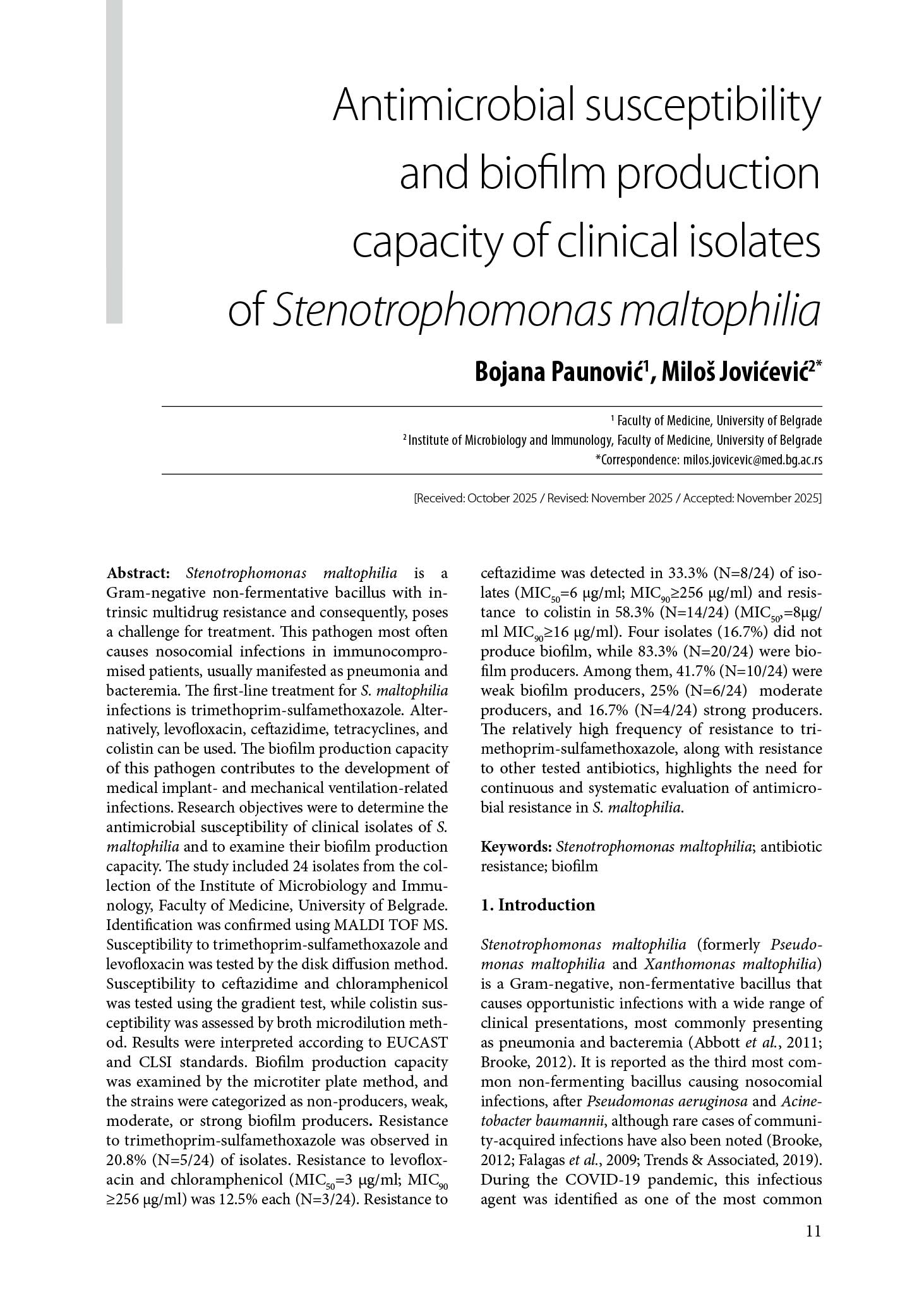
Stenotrophomonas maltophilia is a Gram-negative non-fermentative bacillus with intrinsic multidrug re-sistance and consequently, poses a challenge for treatment. This pathogen most often causes nosocomial infections in im-munocompromised patients, usually manifested as pneumonia and bacteremia. The first-line treatment for S. malto-philia infections is trimethoprim-sulfamethoxazole. Alternatively, levofloxacin, ceftazidime, tetracyclines, and col-istin can be used. The biofilm production capacity of this pathogen contributes to the development of medical implant- and mechanical ventilation-related infections. Research objectives were to determine the antimicrobial susceptibility of clinical isolates of S. maltophilia and to examine their biofilm production capacity. The study included 24 isolates from the collection of the Institute of Microbiology and Immunology, Faculty of Medicine, University of Belgrade. Identification was confirmed using MALDI TOF MS. Susceptibility to trimethoprim-sulfamethoxazole and levofloxacin was tested by the disk diffusion method. Susceptibility to ceftazidime and chloramphenicol was tested using the gradient test, while colistin susceptibility was assessed by broth microdilution method. Results were interpreted according to EUCAST and CLSI standards. Biofilm production capacity was examined by the microtiter plate method, and the strains were categorized as non-producers, weak, moderate, or strong biofilm producers. Resistance to trimethoprim-sulfamethoxazole was observed in 20.8% (N=5/24) of isolates. Resistance to levofloxacin and chloramphenicol (MIC50=3 µg/ml; MIC90 ≥256 µg/ml) was 12.5% each (N=3/24). Resistance to ceftazidime was detected in 33.3% (N=8/24) of isolates (MIC50=6 µg/ml; MIC90≥256 µg/ml) and resistance to colistin in 58.3% (N=14/24) (MIC50,=8µg/ml MIC90≥16 µg/ml). Four isolates (16.7%) did not produce biofilm, while 83.3% (N=20/24) were biofilm producers. Among them, 41.7% (N=10/24) were weak biofilm producers, 25% (N=6/24) moderate producers, and 16.7% (N=4/24) strong producers. The relatively high frequency of resistance to trimethoprim-sulfamethoxazole, along with resistance to other tested antibiotics, highlights the need for con-tinuous and systematic evaluation of antimicrobial resistance in S. maltophilia.

Continue ReadingVolume #46 – 2 – 2

Volume #46 – 2 – 1

The agroforestry and agri-food industry produce a flow of waste and by-products that have to be dealt with due to their high pollution potential. Value-added wood biomass by-products find applications as a fuel, insulation material, waste-based biosorbents for the removal of a wide range of water pollutants, filler in biogenic plastics and building block. Medicinal mushrooms by-products are commonly employed as animal feed, fertilizer, bio-based materials for bioremedia-tion and energy production. Moreover, residues and the sawdust from medicinal mushroom and wood cask are recog-nized for their high phenolic content. Consequently, they hold promise as functional components, which supports their integration into various products. Dried, ground, and sieved post-extraction residues from the medicinal mushrooms Phel-linus linteus and Phellinus igniarius (4%), as well as wood sawdust from myrobalan plum (Prunus cerasifera), black locust (Robinia pseudoacacia), cherry (Prunus avium), and mulberry (Morus alba) obtained from a Balkan cooperage (2%), were added at the beginning of yogurts fermentation. Fermentation kinetics, syneresis rates and the viability of lactic acid bacteria (LAB) were evaluated. Results obtained indi-cate that selected agri-food by-products (AFP) do not disturb fermentation dynamics, nor modify syneresis rates. High LAB viability was maintained (up to 9.02±0.48 log CFU/mL). In conclusion, these results provide a good starting point for the development of yogurt formulated with selected agri-food by-products.

Continue ReadingVolume #46 – 2 – 1

Volume #46 – 1 – 4

Urine culture remains the cornerstone of timely and accurate diagnosis of urinary tract infections (UTIs), providing definitive identification of the causative pathogen and enabling administration of the targeted antibiotic therapy. This review aims to support evidence-based clinical decision-making and to reinforce the central role of microbiological diagnostics in the com-prehensive care of patients with UTIs. This narrative review emphasizes the importance of standardized urine sampling, pre-cise identification of causative agents (e.g., Escherichia coli, Klebsiella spp.), accurate antimicrobial susceptibility testing, and the correct interpretation of laboratory reports. Besides, this review provides a comparative overview of relevant national and international guidelines, including the Serbian national clinical practice guide, as well as protocols issued by European, American, and Australian health authorities. This paper highlights the importance of local resistance surveillance and the ex juvantibus approach (initiating treatment based on likely clinical benefit in the absence of immediate diagnostic confirmation) in guiding empirical therapy, as well as the need for close cooperation between microbiologists and clinicians to ensure the accuracy, relevance, and time delivery of microbiology reports. In conclusion, urine culture remains essential for accurate diagnosis and targeted treatment of UTIs. Standardized sampling, proper interpretation, and adherence to clinical guidelines improve patients outcomes. Local resistance data and, when needed, the ex juvantibus approach support effective empirical therapy.

Continue ReadingVolume #46 – 1 – 4

Volume #46 – 1 – 3

Streptococcus pneumoniae (S. pneumoniae) is the leading cause of bacterial meningitis, a disease associated with significant morbidity and mortality. Beyond direct neuronal injury, S. pneumoniae induces profound neuroinflammation, contributing to synaptic dysfunction and long-term cognitive impairment. One of the key pneumococcal virulence factors, pneumolysin (Ply), plays a critical role in neuroinflammation and synaptic pathology by disrupting the blood-brain barrier (BBB), inducing glutamate excitotoxicity and promoting synaptic loss. This review explores the molecular mechanisms underlying neuroin-flammation in pneumococcal meningitis and its impact on synaptic function, highlighting potential therapeutic targets to mitigate neurological sequelae.

Continue ReadingVolume #46 – 1 – 3

Volume #46 – 1 – 2

Antimicrobial resistance poses a significant threat to global health, demanding innovative and scalable responses. This article examines the integration of artificial intelligence/machine learning technologies into the surveillance and clinical management of antimicrobial resistance, highlighting recent advancements and their potential to transform the field. By aligning these technologies with national strategies and clinical practice, particularly in settings such as Serbia, the paper underscores the importance of interdisciplinary collaboration in developing effective decision-support tool for empirical antibiotic therapy tailored to real-world healthcare environments revived in the project idea, Machine Learning Utilization for Data-Driven Empirical Therapy and Antimicrobial Resistance Management, developed by a group of researchers from four Serbian facul-ties.

Continue ReadingVolume #46 – 1 – 2

Volume #46 – 1 – 1

Cultural heritage materials, from centuries-old documents to historic buildings, are constantly at risk from microbial damage caused by fungi, bacteria, and algae. These organisms can weaken structures, fade pigments, and leave behind visible stains. While synthetic chemical biocides have long been used to stop such deterioration, they often come with drawbacks: potential harm to conservators, negative environmental impact, and the risk of damaging fragile materials. In recent years, essential oils (EOs) have gained attention as a safer, more natural alternative due their antimicrobial and antifungal properties. Nev-ertheless, using essential oils is not without challenges. Their quick evaporation, sensitivity to light and heat, and lack of standardized guidelines can limit their effectiveness. However, with growing interest and new technologies that control how EOs are released, they are becoming a more reliable option. Essential oils may not replace traditional methods entirely, but they offer a more sustainable, health-conscious, and adaptable solution for protecting our shared heritage. Therefore, this review highlights how essential oils are applied in conservation, from simple brushing and spraying to more advanced sys-tems like hydrogels, vapor diffusion, and microemulsions. These methods aim to improve the stability of EOs and make their effects last longer without harming the objects.

Continue ReadingVolume #46 – 1 – 1